Patio Installation in Norwich
A patio is a paved outdoor living area laid on a compacted, drained sub-base, usually in porcelain, natural stone or concrete slabs. In Norwich, a professionally installed patio lasts 20 years or more, and porcelain is the lowest-maintenance option in the damp Norfolk climate.
Where the patio is part of a wider garden project, we handle the garden landscaping too. Levels, drainage and planting are easier to get right when they are planned together rather than one after the other.
What makes a Patio last in the Norfolk Climate?
Norfolk rainfall makes drainage an important part of patio design. Before laying the paving, we consider how surface water will move away from the building and where it can discharge without causing problems for walls, neighboring boundaries, flower beds, or other parts of the garden.If the patio runs up to a fence line, we set the fall so water drains away from the posts, since a post sitting in wet ground is the most common reason a garden fence in Norwich fails within ten years.
The patio is installed with suitable falls for the site and paving system. The fall should be effective without making the surface uncomfortable to use or creating an awkward transition at the house. Where a permeable solution or additional drainage is appropriate, the complete design must be assessed, including the surface, base, surrounding ground, and discharge route. A universal gradient should not be assumed without considering the specific project.
Norfolk gives a patio two things to survive: damp winters that encourage algae on porous surfaces, and freeze-thaw cycles that lift anything laid on a base that holds water. Both are drainage problems before they are material problems. A patio with the correct fall away from the house, on a properly compacted sub-base, will outlast a more expensive slab laid flat.
The same principle applies to a block paving driveway: the surface is the part you see, the base is the part that decides how long it lasts.
Porcelain vs Natural Stone vs Concrete: choosing your Patio Slabs
When you search for patio slabs rather than paving, you usually mean large, flat units laid across a garden. Block paving is different: small, brick-sized blocks that lock together, built to carry a car on a block paving driveway. Slabs are wider, so a patio has fewer joints, and we lay every slab on a full mortar bed.
Most patios use rectangular slabs, with 600 x 600mm and 900 x 600mm the common sizes, often mixed in one layout. Porcelain slabs are usually 20mm thick with an even face. Natural stone comes riven, with a split, uneven surface, or sawn smooth.
Before you choose, it is worth comparing how much water a slab absorbs, whether it needs sealing, how its colour changes with age, and how hard it is to cut, since that shows up in the labour. The sections below set out how each material behaves through a Norfolk winter and what it needs looking after.
Porcelain
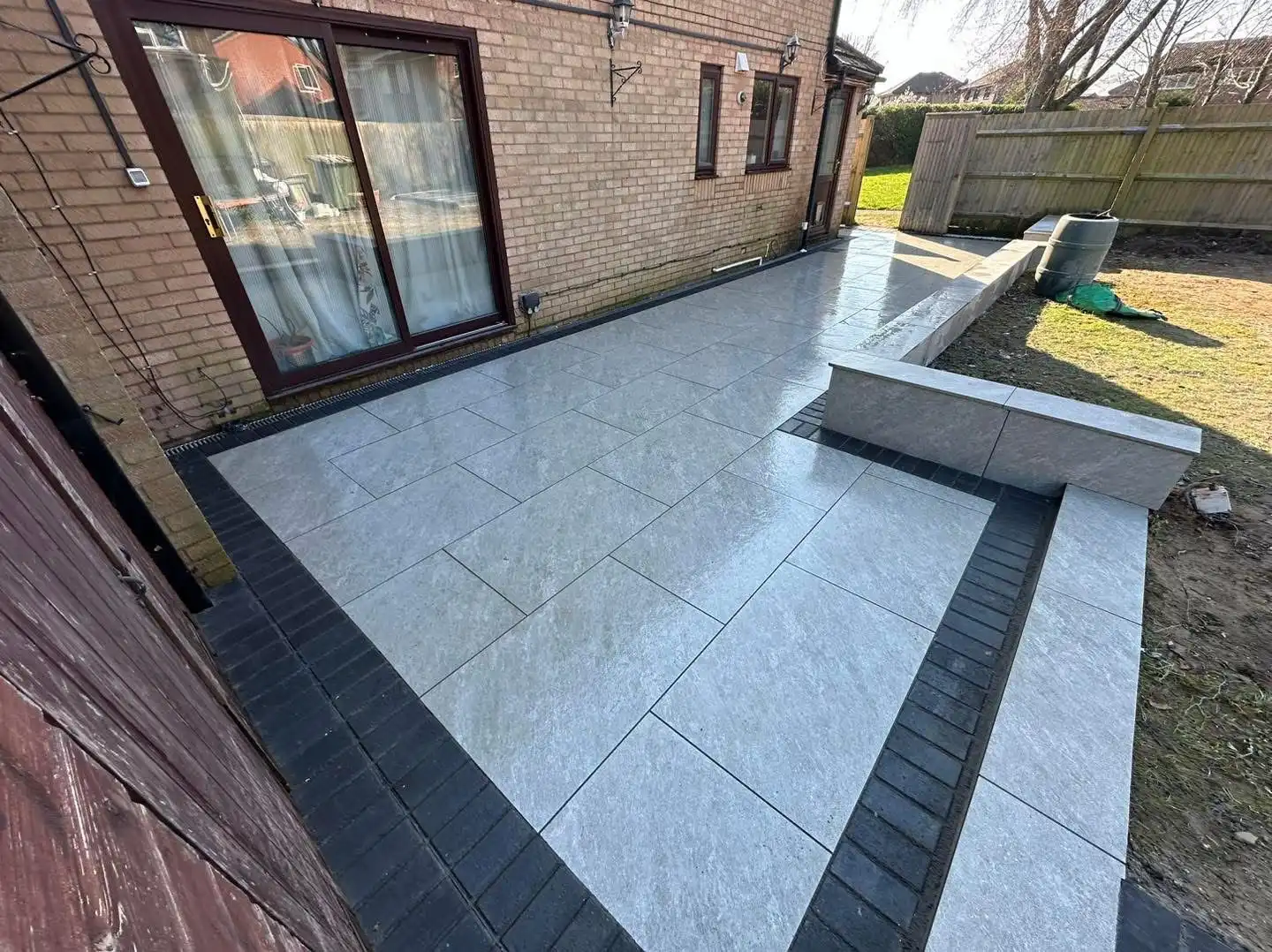
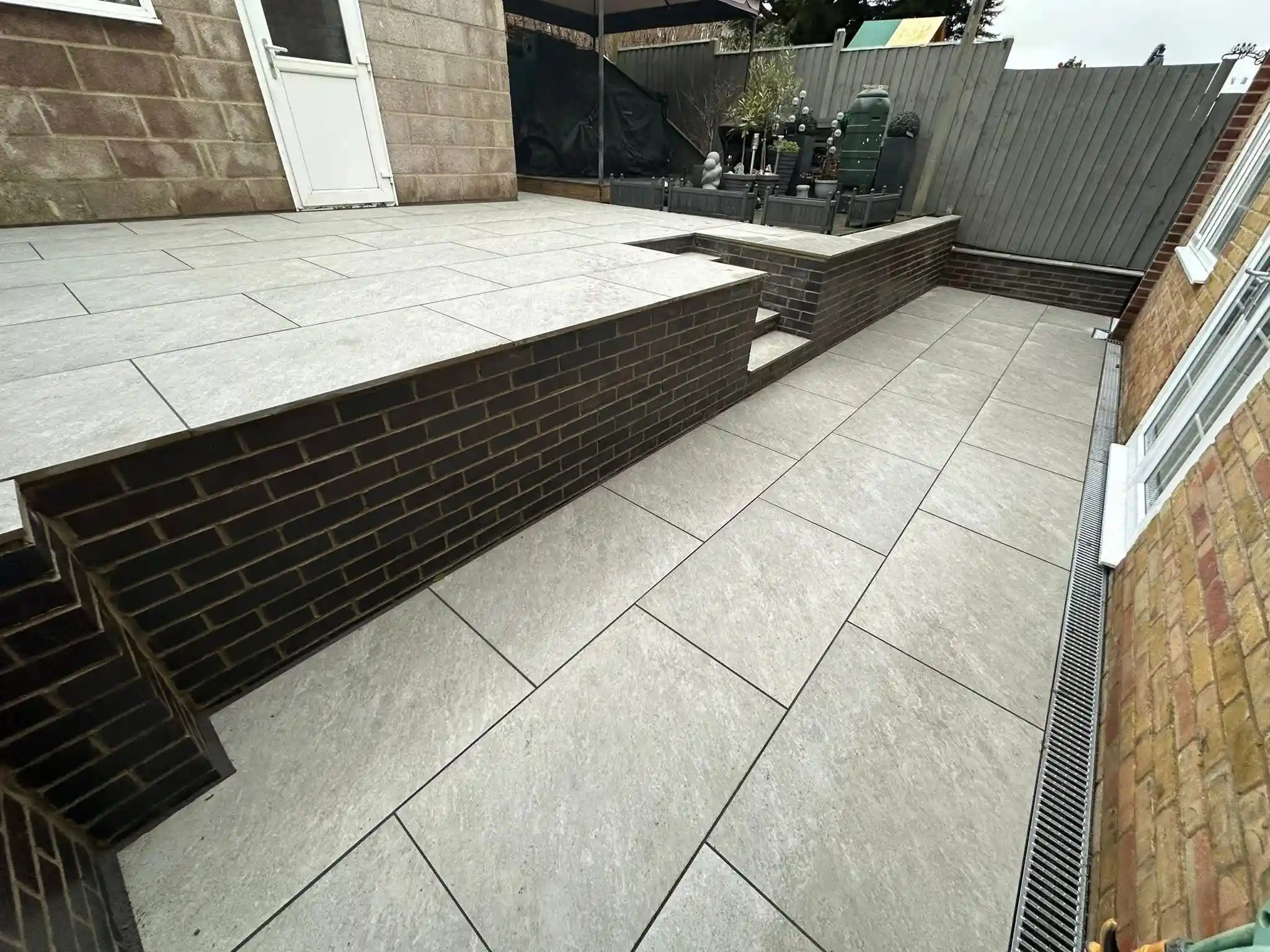
Porcelain is a manufactured slab, fired at high temperature and usually 20mm thick for patios. It comes plain or printed to look like sandstone, slate or timber. Its water absorption is below 0.5%, so in a Norfolk winter frost has almost nothing inside the slab to expand, and algae finds little to hold on to, even where a north-facing patio stays wet for weeks. The weak point is the joints: water in a cracked joint freezes and loosens the slabs. It never needs sealing. A spring brush and wash keeps it clean, and the colour barely changes with age. We lay porcelain paving in Norwich for modern houses and owners who want little upkeep. It is harder and slower to cut than stone, which shows in the labour.
Sandstone
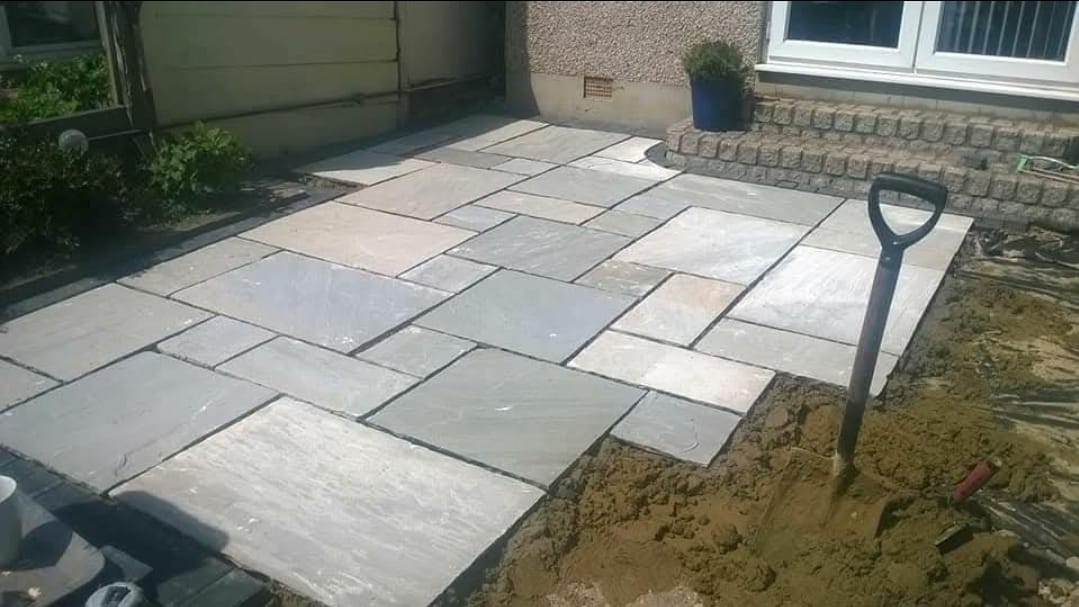
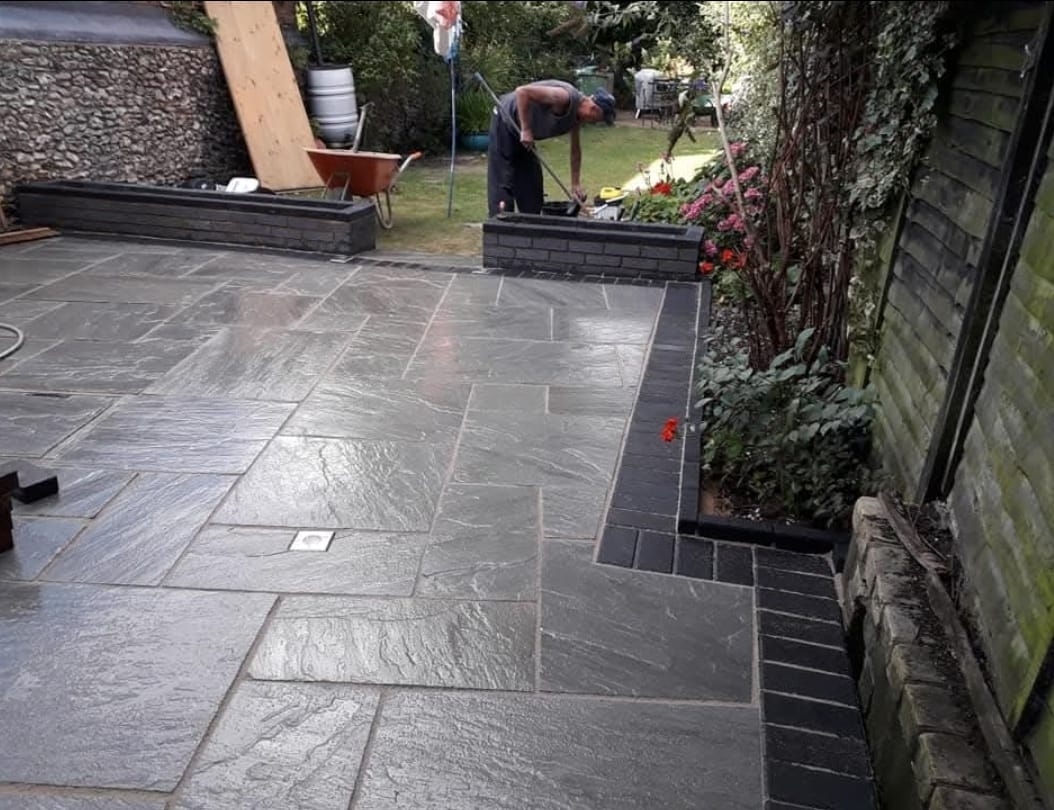
Sandstone is the most common patio stone in Norfolk. Most sandstone paving in the UK comes from India, in greys, buffs and browns. Riven slabs are split along the grain and have an uneven face; sawn slabs are machine-cut and smooth. The stone is porous. Over a Norfolk winter, a north-facing corner where damp lingers for weeks goes green by spring, black lichen spots often follow, and wet joints can crack in a hard frost. Sealing cuts how much water the stone takes in, yet the green still returns, so plan on a spring clean and resealing every three to five years. The colour softens as it weathers. You can see the sandstone patios we have completed in our gallery. It suits period houses and cottage gardens.
Slate
Slate is a dark grey, fine-grained stone. It forms in thin layers and splits into flat slabs, and its colour deepens almost to black when wet. A riven face has a slight ripple that grips underfoot. Slate takes in far less water than sandstone, so it greens up slowly, even on north-facing ground that stays damp for weeks. In a Norfolk winter the risk is at edges and joints. A rough cut lets water between the layers and frost flakes the edge, so every cut needs a clean finish. Upkeep is a twice-yearly wash. Mortar bloom can show at first and fades with cleaning, and good slate holds its colour. We install slate paving across Norwich and Norfolk. It suits modern houses and small, formal gardens.
Granite
Granite is the hardest stone used for patios, in silver greys, charcoals and speckled blacks. It resists scratches and stains better than any other stone here. Outdoor slabs usually have a flamed finish: the surface is heated until the top crystals flake off, which leaves a fine texture that grips when wet. In a Norfolk winter its low porosity gives frost little water to work on, and algae struggles to settle, even where the ground never dries out. Frost damage usually starts in the joints, not the slab. Beyond a yearly wash there is little to do, sealing is optional, and granite paving looks much the same after twenty years. It is expensive and slow to cut. Granite suits contemporary houses and patios that take heavy use.
Limestone
Limestone is a sedimentary stone, softer than granite, with a smoother and more even face than sandstone. Kota blue from India is one of the most popular types for UK patios. In a Norfolk winter, when rain keeps it wet for weeks, it soaks up more water than granite or porcelain. Shaded, north-facing corners turn green, wet joints can crack in a hard frost, and leaves, berries and bird droppings from overhanging trees leave marks that are hard to shift. Limestone paving needs sealing soon after laying and again every few years. Avoid acid-based patio cleaners, because acid etches the surface. Over time it mellows to a lighter shade. It suits modern or classic houses where the patio sits clear of trees.
Concrete
Concrete patio slabs are pressed or cast in moulds, with pigment added for colour. Modern riven and stone-effect finishes are moulded from real stone and are hard to tell apart immediately. Pressed slabs made to BS EN 1339, the British standard for concrete flags, are tested for frost resistance and cope with a Norfolk winter. They hold some moisture, so shaded, north-facing areas that stay damp green up, and cracked joints let frost work under the slabs. In the first year a white bloom called efflorescence can appear; it usually weathers off. Over the years sun and rain wear the pigment, so they fade more than porcelain. A sealer slows this. As the most economical paving slabs of the six, they suit large areas and rental properties.
Put side by side, porcelain and granite take on the least water, so they ask the least of you after a wet winter. Slate comes close behind. Sandstone and limestone look the most natural, and both need sealing and a spring clean to stay that way. Concrete costs the least to buy and fades first. Whichever you choose, the fall and the sub-base will decide how long the patio lasts.
How much does a Patio Cost in Norwich?
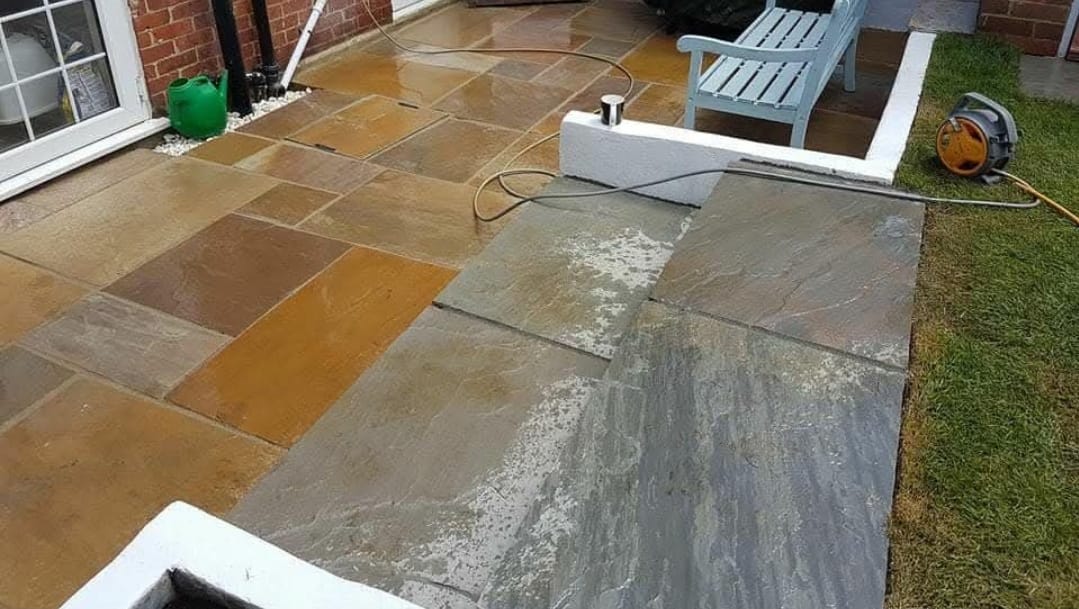
Slab choice moves the price most. Concrete slabs sit at one end, natural stone in the middle, porcelain at the upper end — porcelain costs more per square metre and is harder to cut, which shows in the labour as well as the materials.
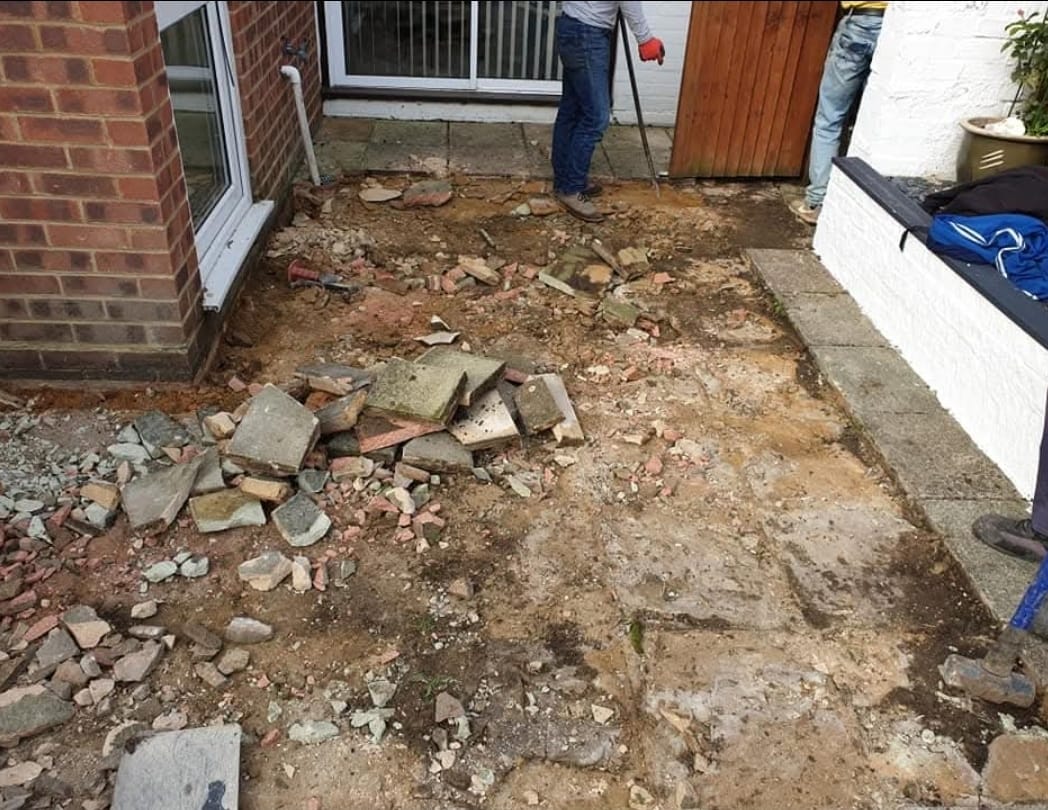
Costed separately on top of that: excavation and groundworks, drainage, steps, and any retaining walls. Those vary more between properties than the slabs do, and they are the reason a per-square-metre figure alone never tells the whole story.
One thing that costs nothing extra and is worth insisting on: a full mortar bed under every slab, not five dabs under the corners. Spot-bedding is the most common shortcut in patio laying and the most common cause of rocking slabs a year later.
Ask for an itemised quote rather than a single number. Ours are free and fixed — call 01603 858680.
Patio Drainage and Falls: Why the Slope Matters
A patio needs a fall of roughly 1:80 away from the house, about 12mm for every metre. Without it, water sits on the surface, and standing water on a patio means algae, slippery slabs in winter, and frost damage over time.
This is the single most common patio complaint we are called out to, and it is the one thing that cannot be fixed afterwards without lifting and relaying the whole patio. It costs nothing extra to get right at the start.
How we Install a Patio
We provide patio installation in Norwich and surrounding Norfolk areas, including Wymondham, Hellesdon, Sprowston, and Costessey. Property layouts, levels, access, and ground conditions vary, so we assess each garden before recommending the most suitable materials, base preparation, edging, jointing, and drainage approach.
If you have an existing patio that is uneven, damaged, difficult to access, or no longer suits the way you use the garden, we can discuss the available options. This may include replacing the paving, improving the layout, adjusting levels, or creating a new outdoor area where the space allows.
We lay every slab on a full mortar bed, not five dabs of mortar under the corners. Spot-bedding is the most common shortcut in patio laying and the most common cause of rocking slabs and cracked corners a year later.
Areas we cover for Patio Installation
We install patios across Norwich and Norfolk, including Thorpe St Andrew, Sprowston, Costessey, Old Catton, Wymondham, Dereham, Cromer and Holt. See all areas we cover.
Patio FAQs
How much does a new patio cost in Norwich?
Slab choice moves the price most — concrete at the lower end, porcelain at the upper. Groundworks, drainage, steps and retaining walls are costed separately and vary more between properties than the slabs do, so ask for an itemised quote rather than a single number.
Is porcelain or natural stone better for a Norfolk patio?
Porcelain absorbs almost no water, so it resists frost damage, algae and staining better than natural stone, a real advantage in Norfolk’s damp winters. Natural stone has more character but needs sealing and more regular cleaning. Porcelain costs more upfront and less over its life.
Do I need planning permission for a patio?
A patio at ground level in a rear garden normally needs no planning permission. Permission may be required if it is significantly raised, if it affects a listed building or a conservation area, or if it is in a front garden and impermeable over 5m². Check with your local planning authority before starting.
How long does it take to lay a patio?
A typical domestic patio of 20 to 30m² takes three to five working days including excavation, sub-base, laying and pointing. Projects with steps, drainage runs or retaining walls take longer. We give a fixed timescale with every quote.
Why does my patio hold water?
Almost always because it was laid flat rather than with a fall. A patio needs a fall of roughly 1:80 away from the house so water runs off. Standing water leads to algae, frost damage and slipping. Fixing a level patio means lifting and relaying it.
What is the best base for a patio?
A compacted MOT Type 1 sub-base of 100 to 150mm over a prepared subgrade, then a full mortar bed under every slab, not five dabs under the corners. Spot-bedding is the most common shortcut and the most common cause of rocking and cracked slabs.